Daniel Haston Family Association
Researching and Preserving the History of Daniel Haston's Extensive Family


Meet at Hickory Valley Baptist Church and ride an air-conditioned bus to (or by) 12 historic sites connected to our Haston family history. Will stop on this guided tour at FIVE (see green bullet points) of the 12 sites for feet-on-the-ground views of where our ancestors lived, died, and were buried. Will drive by the other (red points) sites that you will have opportunities to visit later.
Sites we will stop and visit:

No lunch will be served at the church. Will be given a map to and of Sparta with locations of restaurants. About eight miles from the church to Sparta.

Arrangements will be made for the White County Heritage Museum (114 South Main Street) and the White County, TN Archives (3rd floor of Courthouse) to be ready to receive you as visitors.
This is the self-direction part of the Haston Historic Sites Tour. This morning we visited FIVE of the 12 historic sites and drove by all 12 of them. This afternoon, we encourage you to go back to and visit any of these sites of particular interest to you.

At the Hickory Valley Baptist Church (fellowship hall) - 5865 Hickory Valley Road; Sparta, TN 38583.
Very important part of the reunion - please don't miss it.

Pick up your name tag, receive your reunion packet, enjoy breakfast snacks, meet some of your previously unknown relatives, visit some of the interest centers.

Retired Major General Max Haston, former Adjutant General of the State of Tennessee, will lead this opening ceremony.

Wayne Haston will present the story of Daniel Haston, his ancestry, and what is known of his life. Participants will be involved in this activity in a fun way.

Jean Ann Haston Hall will explain why we created the Daniel Haston Family Association, a 501 (c)(7), organization and how you can help us preserve our Haston family history and heritage.
Harris Haston will tell you about the Big Fork Historic Cemetery, Inc., a 501 (c)(3)organization, why the cemetery is truly historic, what we have accomplished since the 2022 Haston Family Reunion, and our plans and needs for future development.

There will several interest centers such as...

The 2023 Hiestand-Haston tour group at the world famous Hiestand Bakery and Bistro in Zürich.

"Back by Popular Demand." Very similar to our 2022 meal, but some extra options for people with various food issues.
We urge you to use this meal time to get to know folks that you haven't known before, rather than to just spend it with the family members and friends that you see often.

A general overview of all of Daniel Haston’s sons and daughters—who they were, what they did, where they lived, with some interesting anecdotes about each of them and their families.
Note: Each participant will receive a blank family tree sheet for participants to take notes.

Prior to this time, submit your question cards about the history of our Haston family. Wayne will pick 30 minutes’ worth of question-answers, especially those of most interest to the entire group. As time permits, he will take other questions as well.


Choose one from these three workshops:


Table groups will compete against each other, with a game show buzzer system to determine who responds first to each question.
Questions covering what has been presented today, including a few BONUS questions from some significant content from the Daniel Haston Family book.
A special prize will be given to each member of the winning table team.

If this year is like the 2022 reunion, we'll have lots of leftovers at the end of the day, food from the lunch meal as well as breakfast goodies. Hang around - mix and mingle some more - reflect on all of the experiences of the day.


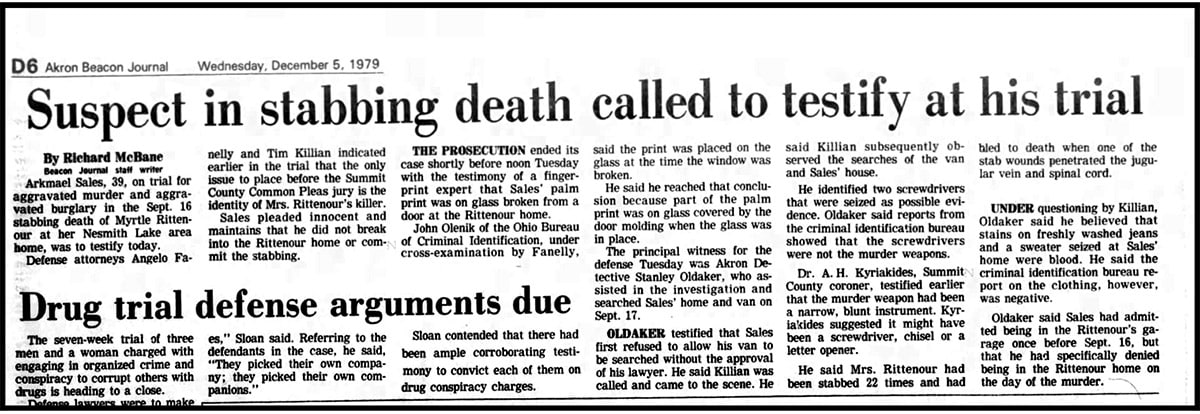
Grace Haston Rittenour was murdered in this house on Sunday evening, September 16, 1979. This photo of the house was taken 32 years later. The canal is located behind the house.

Myrtle was her first name and also the name of her mother. But she was commonly known by her middle name, Grace.

Arkmael Sales, the murderer, was soon captured, and two days after the murder, details about the crime were revealed. Sales was charged with aggravated burglary and aggravated murder.


Her parents, Charles Beason and Myrtle (Wallace) Haston died in 1953. Her older sister, Edna Haston Moss, died in 1976.


Arkmael Sales (right) talks with lawyer, Tim Killian during trial in Summit County (Ohio) Common Pleas Court


Posted December 29, 2021:
I am A.Ray Sales, 80 years young (born June 15, 1941), Black, 5’9”, wgt 164, single, heterosexual. Have my GED and some college. Love to read, fish, work with animals, children. Hope to be released in March 2023 and plan to start a refurbishing business upon release. Recovered lung cancer patient. Has very little family, all lost during my confinement. Never married. Will respond to all regardless of age. NOTE: I can receive ONLY letters via SNAIL MAIL; otherwise I cannot respond.


David Haston and Family in White County, Tennessee | |||
1806 | Move to White County, TN: David moved to White County, to join his father Daniel, his brother Joseph, his sisters Catherine [later, Austin] and Lucinda (Mitchell), and perhaps other family members, sometime between November 11, 1806, and February 10, 1808. He had already sold his land, so he may have left Knox County in November after he served as auctioneer for the Jacob Neff estate settlement. This timing is in harmony with a return trip from White County to the Knox County area that his brother, Joseph, may have made. Perhaps Joseph led David to the new Haston home place in White County. Daniel's wife (who was David's mother or stepmother) may have remained in Knox County until this time. | ||
1808 | Road Work Appointment in White County, TN: David was one of the men "...appointed to lay off and mark a road the nearest and best way from where the Chickamogga trace [ancient trail] crosses the White County line on Cumberland Mountain the nearest and best way that leads to Warren County line." This is the first known record of David in White County. Joseph Smith, Isaac Midcalf, David Haston, William Brown, Joseph Cummings, and Joseph H. Creely comprised this road crew. These men all lived in the same general area, along the Caney Fork River. Note: Joseph Haston married Sarah Creely. | ||
1808 | David and Isham Bradley Chain Carriers: David and Isham were chain carriers for Jacob Mitchell's survey of 50 acres on the big spring branch of Cane Creek on May 14, 1808 and for Joseph Haston's survey of 50 acres on June 18, 1808. | ||
1808 | Fourth Child (Daniel MC.) Born:* Daniel Mc Haston married (1) Annie Green in 1827 (daughter of John & Rachel Mackey Green; John Green was an elder of the Big Fork Baptist Church)** and (2) Martha Jane Wade on June 10, 1839. A published biographical sketch*** of his son, J.P. Hastain, says that "In 1834 the family (i.e. Daniel MC's family) removed to Missouri, and first located in Henry County, being among the pioneer settlers there." A similar biographical sketch*** for another son of Daniel Mc. Hastain, P.D. (Pleasant Dawson) Hastain, also states that "Daniel M. Hastain was reared in Tennessee, but came to Missouri in 1834, locating in Henry County. He...became one of the large landowners of that section." This Daniel Hastain died on June 17, 1875 (or 1874 as per the P.D. Haston bio sketch) in Henry County, MO. In Missouri, the spelling of Haston was changed to Hastain. Daniel MC Hasting appeared on the 1832 White County, TN tax list, apparently living near his father-in-law (John Green) in the Lost Creek area of upper Hickory Valley. He owned 50 aces. His name was clearly written as "Daniel MC." He also appeared on the 1833 & 1834 tax lists for the same area. Move to Henry County, MO Rev. Henry Avery was the first white permanent settler in the area that became Henry County, MO. He married Elizabeth Green, daughter of John Green (Greene) of White County, TN. John Green was a minister of the Big Fork Baptist Church for many years. This means that Rev. Henry Avery and Daniel M.C. Haston (who later changed surname spelling to Hastain) married sisters, daughters of John Green. Shortly after Henry Avery settled in Henry County, MO, Daniel M.C. Haston apparently joined him. William M. Doyle (son of James H. Doyle who lived very near the Big Fork Baptist Church) also went to Henry County, MO with the Avery family. Rev. Henry Avery was a pioneer hero and cherished Baptist minister in early Henry County, MO. Source: Pages 492-496 of The History of Henry and St. Clair Counties, Missouri (St. Joseph, MO: National Historical Company, 1883). There are numerous other references to Rev. Henry Avery in this book. 
When Daniel MC Haston's father-in-law, John Green, died in the early 1850s, it appears that Daniel MC Haston traveled from Henri [Henry] County, MO (where he then lived) back to White County, TN to claim the inheritance for various heirs of John Green. These heirs were scattered in Missouri, California, & the Oregon Territory. These heirs were probably his (David MC Haston's) children. | ||
1809 | Grand Jury Duty: David was a member of "the Grand Jury empannelled and sworn for the County of White." Isham Bradley (bondsman for David's marriage in Knox County) was also a member of this jury. | ||
1809 | Witnessed Isham Bradley Land Transaction: David Hastin, Joseph Hastin, Jacob Mitchell, and John Miller were witnesses for a sale of 50 acres that Isham Bradley made to Charles Mitchell for $400. The land was on the Big Spring Branch. Isham Bradley earlier acquired the land from the state of TN through Grant # 529. | ||
1809 | David Purchased Land in White County, TN: David purchased 50 acres of land from his brother Joseph for $200, on the same day that they both witnessed the Isham Bradley to Charles Mitchell deal (see above). Joseph had acquired this land through TN land grant # 550. The land adjoined property owned by Isham Bradley, Jacob Mitchell, and Daniel, his father. Isham Bradley, Charles Mitchell, and John Miller witnessed the transaction. | ||
1809 | Jury Duty: David's name appears four times in this day's court minutes, related to various court cases for which he served as a juryman. | ||
1809 | Joseph to David Land Purchase "Proven" in Court: The 50-acre purchase of land that David made from his brother, Joseph, was "proven in court by the oaths of Isham Bradley and Charles Mitchell and admitted to record." It was registered at this time, although the deed was recorded on February 15 of the same year (see above). | ||
1809 | David "Proves" Isham Bradley's Sale of Land to Charles Mitchell: Earlier in this same year, on February 15, David and Jacob Mitchell had witnessed a sale of land from Isham Bradley to Charles Mitchell. As per the November 14 court record, "...this day [the transaction was] proven in open court by the oaths of David Haston and Jacob Mitchell and ordered to be recorded." It was then officially registered. | ||
1809 | Summoned to Jury Duty for February 1810 Session: David was summoned as one of the "persons to attend at the Court house in said County [of White] on the second Monday in February next to serve as Juror." Among the others summoned were Robert Gamble and John Scoggins (two of the first elders of Union Presbyterian Church), Hercules Ogles, Stephen Crain, Isaac Pruett, Andrew McBride, Christopher Steakley, and Isaac Brown. These men probably lived near the Hastons. | ||
1810 | Jury Duty: As per the earlier summons (November 17, 1809), David reported for jury duty in this February 1810 County Court session but there is no evidence that he was actually impanelled as a juryman from among the larger group summoned. | ||
1810 | Road Work Assignment: It was "Ordered by Court that Joseph Smith, Esqr. David Haston, William Preuitt, Henry Holt, and Jacob Mitchell be appointed to review and straighten the present road leading from Bledsoe County to Warren County to commence at a point near David Haston's field and to intersect the present road East of Joseph Smith's at the most convenient place and make report thereof to the next Court, and the same is ordered accordingly." So, we know that this Bledsoe County to Warren County road ran by David Haston's field. | ||
1810 | Road Assignment Report: "Present to an order of this Court at February term 1810 for reviewing and straightening the road leading from David Haston's to intersect the road East of Joseph Smith, the reviewers for that purpose appointed this day exhibited their report which was received and established. It is, therefore by the Court ordered that the Overseer of the old road, do open and keep in repair the road as marked by the reviewers aforesaid and that the usual hands to ____ the same, and it is ordered accordingly &/c. | ||
1810 | Summoned to September 1810 Circuit Court Jury Duty: David was "named to attend as Jurors at the Honorable the Circuit Court for to be holden in the County of White at the Court house in Sparta on the first Monday in September next." In addition to David, some of the others summoned were John Bryan, William Burden, John White, Nicholas Gillentine, Isaac Medcalf, and Joseph Smith. | ||
1810 | Road Work Appointment: It was "Ordered by the Court that Jacob Stipe, David Haston, Jacob Mitchell, William Brown, Christopher Steakley, Spencer Mitchell, and Nicholas Gillentine be appointed to review lay off and Mark a road the nearest and best way from David McDaniels passing by John Whites so as to intersect a road leading by Joseph Smiths, East of where he lives and the same is ordered accordingly." | ||
1810 | Road Work Report: On November 13, 1810, it was "Ordered by Court that the road reviewed and marked from David McDaniels passing by John Whites so as to entersect a road leading by Joseph Smith's East of his residence be established and the same is ordered accordingly. David's name doesn't appear in the abstract for this entry, but he was part of this road crew as assigned on May 19 of the same year. | ||
1810 or 1811 | David Was a Church Clerk: "The Cumberland Presbyterian congregation met in Old Union Church which was organized about 1811 by Rev. William Barnett. Spence Mitchell, Robert Gamble, and Jesse Scoggins were the first elders, and David Haston was the first clerk." (See the locations on the map below of Old Union and David Haston's home place.)
Note 2: It is interesting that the Big Fork Baptist Church existed at this time and was much closer to the Haston family (and did not require crossing the Caney Fork River) than the Presbyterian church that was located north of the Caney Fork River on land owned by Spencer Mitchell. There is evidence that some members of Daniel Haston's family were affiliated with Baptist churches back in Virginia as well as in East Tennessee. Did David Haston, and perhaps other family members, align with Presbyterians while they were in Knox County? The Presbyterians were definitely the majority denomination at that time in Knox County.  | ||
1811 | The First White County, TN Census (List of Taxable Inhabitants): David Hastin and Joseph Hastin appeared in the list for Captain Isaac Pruett's* Company of Militia as taken and returned by Joseph Smith, Esq. on January 1, 1812. Daniel's name does not appear on this list. Daniel was too old to be considered a "taxable inhabitant" on the militia census. One transcribed source (Pioneers of White Co, TN by W.J.H. Phillips; TN 976.89 White PHI) says that these names are David Harton and Joseph Hastin, but the original document clearly reads "David Hastin" and "Joseph Hastin." | ||
1811 | White County, TN Tax List: David Hastin appeared on this list of taxable property and polls, in the bounds of Captain Isaac Pruett's militia company. He owned 50 acres "by grant" on Caney Fork. His total tax bill for the year was .75, which included .18 3/4 for "State Tax" and 56 1/4 for "County Tax." He was charged for one "white poll," but was not charged for any "black polls" (owned no slaves), nor "steed horses," nor "retail stores," nor "town lots." Note: From the White County, TN tax lists we learn that none of the early White County Hastons (Daniel, David, Joseph, & Isaac) ever owned slaves, although their neighbors sometimes did. | ||
1811 | Appointed to Appraise Property Values: It was "Ordered by Court that the following persons be appointed to value property To wit: ...David Haston, Thomas Meek and John Ogle in the bounds of Capt Joseph Smith's Company." | ||
1811 | Fifth Child (Isham Bradley) Born:* Isham Bradley Haston (later changed to Hastain) married He died February 16, 1867, in Hickory County, MO. In 1850 he was living in the same district of Hickory County, MO where his namesake, Isham Bradley, lived in the early 1840s. | ||
1811 | Paid for One Day of Jury Duty: It was ordered by the Court that David Haston (among others for various amounts of jury duty) should be paid for a 1d (one day) juror ticket. It appears that payment for one day of jury duty was worth about 85 cents. | ||
1812 | David Witnessed a Sale of Land: David Haston, Woodson P. White*, and William Glenn witnessed a sale of 100 acres of Grant # 3496 by Nathan Woods to Margaret Boyed (spelling?). | ||
1812 | David Purchased More Land: David purchased 50 acres from Charles Mitchell for $610. This was the same tract of land (TN Grant # 529) that Isham Bradley had sold to Mitchell (for $400) on September 26, 1808. David Haston was a witness to the Bradley to Mitchell deal (see above). It was located in the 3rd District on Big Springs Branch. | ||
1812 | Appointed Road Crew Overseer: It was "Ordered by Court that David Hastin be appointed overseer of the road leading from Sequache to McMinnville, from the top of the Mountain near Cranes, to the house of a Joseph Smith, and that Nicholas Gillentine Esqr. furnish a list of hands to work there on, and that he keeps the same in repair as the law required. -Issd. Feby.18th, 1812." | ||
1812 | Summoned to Jury Duty at Next Court Session: David Hastin and some of his neighbors, John White, John Scoggins, Jnr., and Isaac Brown, were "appointed as Jurors to attend the Next term of this Court." | ||
1812 | Appointed to Road Work Crew: It was "Ordered by Court that Thomas Bronson be appointed overseer of the road from Robert Gamble to Joseph Smith and that he keep the same in repair agreeable to law and that Nicholas Gillentine and Joseph Smith Esqr. be appointed to apportion the hands, amongst said Thomas Bronson, David Hastin, and John Hill, so as to keep in order their respective roads, and it is ordered accordingly." | ||
1812 | Purchased 50 Acres: On this day Charles Mitchell conveyed 50 acres of land to David Hastin. The conveyance "Was this day proven in open Court by the oaths of Nicholas Gillentine and Nathan Woods." This was probably the same tract of land that Isham Bradley sold to Charles Mitchell in 1809. | ||
1812 | Authorized to Purchase Road Work Tools: It was "Ordered by Court David Hastin, John Hill, and Peter Carter Overseer of the road leading from Sequache Valley to the Warren County line, be authorised [sic] to procure one Sledge Hammer, one crow bar, and one set of blowing tools, for the purpose of removing the rocks out of said road..." | ||
1812 | David Witnessed Another Land Transaction: Joseph Cummings, David Haston, and Nathan Woods witnessed a sale of 50 acres land by John Smallman (Smallwood?) to Nicholas Gillentine. It was located in the 1st District, 1st Range, and 10th Section on the south side of Caney Fork in Beech Cove. On the 9th day of this same month, David "proved" this deed by oath in open court. | ||
1812 | White County, TN Tax List: Daniel Hastin, David Hastin, and Joseph Hastin appeared on this "taxable property and polls" list in the bounds of Captain Isaac Pruett's Company of Militia. The listing was taken by Joseph Smith, Esq. David's total tax was .50 (.25 for state tax and for county tax). It seems that the county tax rate dropped from the previous year, despite having doubled the size of his farm. His land holdings had increased to 100 acres, from 50 acres. Again, he was charged for one white poll. | ||
1813 | Signed Two Contradictory Petitions: David Haston signed a petition from Peter Hoodenpile to the TN General Assembly to be permitted to create a toll turnpike from Bledsoe County into White, Warren, and other counties of TN.
| ||
1813 | Sixth Child (Thomas C.) Born:* Information on Thomas C. Haston was discovered in the late 1990s. He married Margaret __?__ and left Tennessee for Missouri after the 1850 census. After Margaret died he remarried in Butler County, MO in 1852. He died in 1853. His two older sons moved to St. Francois County, MO. The two youngest children went to unrelated families in Arkansas. We do not know what happened to the two middle children.** | ||
1813 | White County, TN Tax List: Daniel Hastin, David Hastin, and Joseph Hastin appeared on this "taxable property and polls" list in the bounds of Captain Isaac Pruett's Company of Militia. The listing was taken by Nicholas Gillentine, Esq. David's total tax was 1.00. Three additional taxes (county purposes tax, court house tax, & poor tax) were added this year. He still had 100 acres, listed as being on Big Spring. Again, he was only charged for one white poll. | ||
1814 | War of 1812 Substitute: David chose not to go to war in the War of 1812. He was 37 years old and had six children to feed by 1814. Instead, he paid William Jones to go in his place. That was a perfectly honorable and legal thing to do at the time. William Jones enlisted in November of 1812. The record reads: Another record shows he was paid 8 dollars per month (48 dollars total). A William Jones witnessed David Haston's sale of 111 acres in Knox County, TN in 1806. Was this the same man? Source: War of 1812 Records for William Jones (available for a fee from Genealogy Quest) | ||
1814 | White County, TN Tax List: Daniel Hastin, David Hastin, and Joseph Hastin appeared on this "taxable property and polls" list in the bounds of Captain Isaac Pruett's Company of Militia. The listing was taken by Nicholas Gillentine, Esq. David's total tax was .56 1/4. The three additional taxes (county purposes tax, court house tax, & poor tax) that were added in the previous year no longer existed. He still had 100 acres, listed as being on Big Spring. Again, he was charged only for one white poll. | ||
1815 | Seventh Child (David Machlin/Macklin Haston) Born:* David Mc. Haston married Parmeely Creely and died before 1900. This son of David, Sr. and Peggy Haston was commonly referred to as David MC (or Mc.) Haston. For example, "David M.C. Haston" appears on the 1836 White County, TN tax list in District 15, where his father lived. He owned no land and this was the first appearance of his name on the tax list, that I have found. In 1836, he would have become 21 years old. He appears frequently in the early Van Buren County court minutes until July 1851. His daughter's obituary (see below) says she "came to Missouri with her parents in 1853" and they settled and resided in Hickory County, MO for about six years before moving to St. Francois County, MO, and settling near the county seat, Farmington, MO. Farmington was about 75 miles southwest of St. Louis and in the "Lead Belt" region in Missouri.
 The MC in his name may have given him in honor of William Machlin IV, the first Secretary of State and Adjutant-General for Tennessee whom his father may have known in Knoxville, or David Wilson McLin, a popular Cumberland Presbyterian minister who was probably an acquaintance of David Haston, Sr. | ||
1815 | White County, TN Tax List: Daniel Hastin, David Hastin, Joseph Hastin, and Isaac Hastin appeared on this "taxable property and polls" list in the bounds of Captain William Denny's Company. The listing was taken by N. Gillentine, Esq. David's total tax was .62 1/2. The poor tax returned this year. He still had 100 acres, listed as being on Big Spring. Again, he was charged for one white poll. | ||
1816 | White County, TN Tax List: Daniel Hastin, David Hastin, Joseph Hastin, and Isaac Hastin appeared on this "taxable property and polls" list in the bounds of Captain William Denny's Company of Militia. The listing was taken by Nicholas Gillentine, Esq. David's total tax was .62 1/2. David still owned the 100 acres on Big Spring. Again, he was charged for one white poll. | ||
1817 | Eighth Child (Loucinda L.) Born:* Loucinda L. Haston was either married to an unknown Mr. Moore or had an illegitimate child (Edward Cyrus Moore Haston) by him. This child was reared by David and Peggy Haston when she married Abraham Greenville Trogden, Sr. (born 1805 in Ohio; died before December 4, 1854) in Van Buren County, TN, soon after the death of Mr. Trogden's first wife, Mary K. Hinds. Mary K. Hinds Trogden died in 1849, leaving Abraham (Sr.) with a large family and an infant child, Abraham Greenville Trogden (Jr.) who was born on August 4, 1849. Loucinda died on December 2, 1902 in Maxwell, (of Franklin County), TN. In the 1900 Warren County, TN census, Loucinda stated that she was the mother of one child born, and no children living. Lynn Schiller was a major source for this information. See Howard H. Hasting, Sr.'s material for more information on this daughter of David and Peggy Haston. | ||
1817 | White County, TN Tax List: Daniel Hasting, David Hasting, Joseph Hasting, and Isaac Hasting appeared on this "taxable property and polls" list in Captain Jesse Scoggon's Company of Militia. The listing was taken by William Denny, Esq. David's total tax was 1.34. A bridge tax was assessed this year. He still owned the 100 acres, now being listed as on the Caney Fork. Again, he was charged for one white poll. | ||
1818 | White County, TN Tax List: David Haston, Joseph Haston, and Isaac Haston appeared on this "taxable property and polls" list in Captain Scoggon's Company. The listing was taken by William Denny, Esq. Daniel Haston was not mentioned, but Isaac appears on the list with 150 acres. David's total tax was .87 1/2. A court house tax was assessed this year. David's 100 acres was said to have been on Cane Creek. He was charged with one white poll. | ||
1819 | Ninth Child (Margrete [Peggy]) Born:* Nothing more is known about this daughter. (as per Haston Ridge web site) | ||
1820 | Federal Census: A David Hasting household is included on this census. There are three males under the age of 10 [these would have been Isham Bradley, Thomas C., & David Mc], two males between the ages of 10 to 16 [Willie B. & Daniel McComiskey], no males in the age 16 to 26 category, one male (presumably David) in the 26 to 45 age range, and one male over 45 years old. Who was this male that was over 45 years old? It doesn't seem to have been David's father, Daniel, since there was a Daniel Haston household consisting of a male and a female in this over 45 category. If the 1777 birth date is correct, David would have been 43 years old in 1820. David's household also included two females under the age of 10 [Loucinda & Margrete], one female between 10 and 16 [Mary "Polly"], one female in the ages 16 to 26 category [Malinda], one female who was somewhere between 26 and 45 years old (presumably Peggy), and no females over 45 years old. The record indicates that there were no slaves in the household. Although the census does not name the children, it does perfectly account for all nine of David's and Peggy's children born up to this time. The census ages match the dates of birth given in the David Haston family Bible. | ||
1820 | Appointed to County Court Jury Duty: David Haston appeared in the county court for jury duty and was "elected and sownr [sworn?] as Jury of Grand inquest for the body of the county of white..." David's neighbor, Daniel Dale, was also on this jury. | ||
1820 | Summoned for Circuit Court Jury Duty: David Haston and others were "summoned as Jurors to attend at the September term of the Circuit..." | ||
1821 | Appeared on a list of debtors: David Hastings appeared on an inventory of debts owed to a deceased Lawson Nourse, who was one of the earliest physicians in Sparta, TN. He was on the "Good Debt" section of the list for a $2.00 debt. There are approximately 800 names on the list. | ||
1821 | Tenth Child (James W.) Born:* James W. married Jane Shockley on October 14, 1841 in Van Buren County. One source says he died in 1858 in Van Buren County.
See Howard H. Hasting, Sr.'s material for more information on this son of David and Margaret Haston. | ||
1821 | White County, TN Tax List: Daniel Hasting, David Hasting, Joseph Hasting, and Isaac Hasting appeared on this "taxable property and polls" list in Captain Scoggon's "old" Company. The listing was taken by Nicholas Gillentine, Esq. David's total tax was 2.91 3/4. In addition to state, county, and poor taxes, a juror tax and a bridge & jail tax were assessed. David's 100 acres were said to have been on Big Spring. As usual, he was charged for one white poll. | ||
1822 | White County, TN Tax List: David Hasting, Joseph Hasting, and Isaac Hasting appeared on this "taxable property and polls" list in Captain Parker's Company. The listing was taken by N. Gillentine, Esq. As on the 1818 tax list, Daniel does not appear, but Isaac appears with the 150 acres on Big Spring. David's total tax was 2.50. His 100 acres were said to have been situated on Big Spring. As usual, he was charged for one white poll. | ||
1822 | Jury duty: David Hasten (WPA transcription spelling) served as a juror for this county court session. | ||
1822 | Appointed for road work: David Hastin (WPA transcription spelling) was appointed to work on the road "leading from Robert Gambles to a branch on top of the mountain East of William Crains..." "Isaac Hastin" and others who lived near the Hastons (example, Aquila Nearn, Jesse Brown, Isaac Brown, Wyatt Ogle, Wm. Brown, Robert Gamble, et. al.) were appointed to the same project. | ||
1822 | Appointed as an election judge: David Hasting (WPA transcription spelling) was appointed, along with Robt. Gamble, Isaac Plumber [sic], as a judge "to hold the money elected for com at McElhineys." | ||
1822 | Appointed Justice of Peace: David Hasting (and James Townsend, John W. Gleason, Stephen Palmer, & William McKinney) "produced in open Court a Commission signed by his Excellency William Carroll, Governor, of the State of Tennessee countersigned by David Graham Esqr. Secretary of State, commissions them as Justice of the peace for said County." The record further states that David and the others "severally took the oaths required by law, and Thereunto are permitted to act as Justices of the peace in and for the County of White, and as Justices of the Courts of pleas and quarter sessions in Said County." | ||
1822 | Appointed to assign workers for road work projects: "David Hastin Esqr." (WPA transcription spelling) was appointed to "assign a list of hands" to work on a road from "John Dales to the caney fork at porters ford." Daniel Dale was the overseer of this project. Thomas Meek was the "overseer of the road from Porters ford on caney fork to the first ford on Cane Creek above Abijah Cranes." "David Hastin Esqr." was appointed to assign hands for this project also.
| ||
1822 | Sitting Justice of the Peace in county court: | ||
1822 | Ordered to receive 1823 tax list: "David Hastings Esqr." was, among others, ordered "to receive the lists of taxable property and polls in...captains companies for the year 1823." David's area of responsibility was "Capt. Parkers Company." | ||
1823 | Sitting Justice of the Peace in county court: | ||
1823 | Assigned a Justice of the Peace classification: "This day the court proceeded to the classification of the Justices of the peace to hold the courts of pleas & quarter sessions for the present year, which was determined by ballot as follows towit: [total of six classes assigned] Question: Is this "classification" simply a scheduling or are there levels of authority associated with the six levels mentioned here? (See also January 9, 1826 entry.) | ||
1823 | Returned tax list to court: "This day David Haston Esqr. returned in open court a list of Taxable property and polls in Capt. Parkers company for the year 1823." (see the 1823 White Co, TN tax list below) | ||
1823 | White County, TN Tax List: | ||
1823 | Unclaimed Mail in Sparta Post Office: David Haston was on a list of people who had unclaimed mail in Sparta, TN. Would love to know who sent that letter and what was in it! | ||
1823 | Eleventh Child (Nancy Jane) Born:* Nancy Jane married (1) McGregor Earles on November 2 or 7, 1843 (wedding performed by primitive Baptist minister, Rev. Ozias Denton**) and (2) Jesse Carrol on November 15, 1853. One source says she died in Warren County, TN, date unknown. | ||
1824 | White County, TN Tax List: Joseph Haston, Daniel Haston, and David Haston appeared on this "list of taxable property and polls" in Captain Arthur Parker's company. The listing was taken and returned by David Haston, Esq. David Haston owned 100 acres at this time. His land was located "on the big spring by D" (D = "ditto" for Caney Fork, in line above). His total tax was 1.70 1/4. David was charged poll tax for one white poll. | ||
1824 | Assigned Road Project Crew: Robert Gamble was "appointed Overseer of the road, from Cane Creek to the house of William Denny." David Hasting Esq. was responsible to "assign a list of hands to work thereon." | ||
1824 | Unclaimed Mail in Sparta Post Office: David Haston was on a list of people who had unclaimed mail in Sparta, TN. | ||
1824 | Entered into Bond for Joseph's Appointment as a Constable: Joseph Hasting was "this day appointed a constable for the full space and term of two years from the date hereof, and thereupon took the oath to support the constitution of the United States, the State of Tennessee and the oath of office, together with the several oaths prescribed by law, and together with David Hasting and Arthur Parker entered into and acknowledge bond in the sum of two hundred and fifty pounds, conditioned as the law requires." | ||
1824 | Assigned Road Crew Workers: It was "Ordered by Court that Robert Gamble be appointed Overseer of the road leading down the Caney fork from where the same leaves the Sequache [sic] Road at the East bank of Cane Creek near Abijah Cranes thence to the top of the mountain at Thomas Schockleys and keep the same in repair as the law requires, and that David Hasting and William Denny Esq. apportion hands between said Gamble and Abijah Crane overseer of one other lot road." | ||
1824 | Sitting Justice of the Peace for Court Session: David Haston was one of the JPs holding court during this week. His name appears at the beginning and/or the ending of each day of court during the period. Note: On Monday, October 11, of this 1824 session (original page 79 of WPA transcriptions), it was "Ordered that Isham Bradley be appointed to take charge of the Court house in Sparta, and keep the doors closed at all times except such times as Court is setting or preaching appointed or something of public interest to be transacted therein &c." However, just prior to the adjournment of court on the same day it was (original page 80) "Ordered by Court that the order appointing Isham Bradley to take charge of the Court house in Sparta be suspended until Monday next for reconsideration; and if not then acted upon to stand rescinded." Isham Bradley was a friend of the Haston family and had been the bondsman for David Haston's marriage in Knox County, some 24 years earlier. On the following Monday, David Haston was not one of the sitting JPs and no record is given, in the WPA court transcriptions for this following Monday session, of Isham Bradley or the job to "take charge of the Court house." | ||
1824 | Assigned Road Crew Workers: It was "Ordered by Court that the road leading from Cane Creek to Thomas Shockleys be divided into two sections, the division to take place at the house of William Denny, that Robert Gamble the present overseer keep in repair that part of the road from Cane Creek to William Dennys and that Thomas Jackson be appointed overseer of said road from William Dennys to Thomas Shockleys and keep the same in repair as the law requires and that David Haston and William Denny Esq assign and apportion the hands between said overseers..." | ||
1824 | Daughter Polly in Bastardy Case: Polly Haston (see her January 29, 1804 entry above) "refused to declare the father of the Bastard child begotten upon her and paid a fine of five dollars as required by law." Her father, David (who was a sitting Justice of the Peace in the court on this day!), then came "into open Court and acknowledged himself indebted to the State of Tennessee in the sum of Five hundred dollars, to the use of the State to be rendered nevertheless to be void on condition that the said Polly Haston shall at all times keep her said child from becoming chargable [sic] to the County of White..." | ||
1825 | White County, TN Tax List: Daniel Hasting, David Hasting, and Joseph Hasting appeared on this "taxable property and polls" list in Captain Parker's Company. The listing was probably taken by David Hasting, Esq. (although his name does not appear on the list). David owned 100 acres at this time. Beginning with this year, land was divided into "school lands" and "other lands." Probably the "school land" was taxable (or at a higher rate) and the other land was not (or at a lower rate). All of his land was in the "other lands" category. His total tax was 1.43 3/4. As usual, he was charged for one white poll. | ||
1825 | Unclaimed Mail in Sparta Post Office: David Haston was on a list of people who had unclaimed mail in Sparta, TN. | ||
1825 | Road Development Assignments: Note: Many other road projects were assigned to various people on this day. Source: Original pages 168-169 of Part 1 of the WPA transcriptions of White County, Tennessee (County Court) Minute Book, 1824-1827. | ||
1825 | Sitting Justice of Peace in County Court: David Hastin was signed in court on this Monday morning as one of the sitting Justices of the Peace. | ||
1825 | Assigns Road Crew Workers: It was "Ordered by Court that Dan Griffith be appointed overseer of the road from the middle of the river at Porters ford on the Caney fork to John Dales and keep the same in repair as the law requires, and that David Hastings Esqr. assign a list of hands to work thereon, road of first class."
| ||
1825 | Appointed as Election Judge: David Hastin, Arthur Parker and Robert Gamble were appointed to be Judges for "the election of Governor of the State, a Representative in Congress, a member of the Senate and home of Representatives in the State Legislature..." These men were Judges for the voting "to be held by William Drury Esqr." | ||
1825 | Unclaimed Mail in Sparta Post Office: David Haston was on a list of people who had unclaimed mail in Sparta, TN. | ||
1825 | Sitting Justice of the Peace in County Court: David Hastings was one of the JPs who presided at this week of "Court of pleas and quarter sessions." His name was on the record each day, morning and/or evening, from Monday through Saturday. William Denny / Denney was also a JP for some of these court sessions. | ||
1826 | White Co, TN Census: Daniel Hastin, David Hastin, and Joseph Hastin appeared on a "list containing the names and number of free male inhabitants of the age of twenty years and upwards resident citizens in Capt. Parkers company on the 1st day of January 1826 taken by David Hasting, Esq." This list was not a typical tax list with property info, etc. given. It was more of a census, similar to the one taken in 1811. | ||
1826 | "Classed" as a Justice of the Peace: It was "Ordered by Court that the Justices of the peace be classed to hold the Courts of pleas and quarter sessions for White County..." "John Bryan, David Hasting, William Warren, Thomas Cooper and Waman Leftwich Esq. to hold the first week of April Court 1826." | ||
1826 | Assigned Road Crew Workers: It was "Ordered by Court that Wyatt Ogle be appointed overseer of the road from William Dennys to Thomas Shockleys and keep the same in repair as the law requires and that David Haston and William Denny Esq. assign a list of hands to work thereon..." | ||
1826 | Reports Tax Information to Court: "This day David Hasting Esq. returned in open Court a list of the taxable property and poles of Captain Parkers Company for the year 1826 which was ordered to be recorded-" | ||
1826 | Presents 1826 Census to Court: "This day David Hasting Esqrs. returned in open Court a list of the census taken in Captain Parkers Company for the year 1826 which was ordered to be recorded-" | ||
1826 | Assigned Road Crew Workers: It was "Ordered by Court that George Yeates be appointed overseer of the road from the middle of the river at Porters ford to the ten mile tree and keep the same in repair as the law requires and that David Hasting Esq assign a list of hands to work thereon it being a road f the first class-" | ||
1826 | White County, TN Tax List: Daniel Hastin, Senr., David Hastin, and Joseph Hastin appeared on this "taxable property and polls" list in Captain Parker's Company. The listing was taken by David Hasting, Esq. David Hastin owned 100 acres at this time, in the "other lands" category. David's total tax was 1.81 1/4. As usual, he was charged poll tax for one white poll. | ||
1826 | Entered into Bond for Joseph's Reappointment as Constable: "This day the Court proceeded to the appointment of a Constable in Captain Parkers Company and to that office do appoint Joseph Hasting for the next two years ensuing who thereupon took the oath prescribed by law and together with William Denny and David Hasting entered into an acknowledged bond in the sum of one thousand dollars conditioned as the law requires." | ||
1826 | Assigned Road Crew Workers: It was "Ordered by Court that Stephen Wallace be appointed overseer of the road from the middle of the river at Porters ford on caney fork, to John Dales and keep the same in repair as the law requires, it being a road of the first class, and that David Hasting Esq. assign a list of hands to work thereon" | ||
1826 | Appointed to Return the 1827 Tax List: "David Hasting Esq in Captain Steakley Company" Although the WPA abstract doesn't call this the 1827 tax list, it appears to be a typical annual assignment of tax roll duties that was given to Justices of the Peace. | ||
1826 | Sitting Justice of the Peace in County Court: David's name does not appear on the Thursday (October 12) morning list of JPs, but it (David Hasting) does appear on the list of JPs at the close of the day. Apparently, he arrived to the court session sometime during the day. He signed in as JP on Friday morning. The transcriber spells David's surname "Hasting." He was not on the JP list for Saturday, October 14. | ||
1827 | Returned Tax List: "This day David Hasting Esqs returned a list of the taxable property and poles in Captain Shockleys Company for the year 1827, which was ordered to be recorded." (see entry below for this 1827 tax list) | ||
1827 | White County, TN Tax List: David Hastin and Joseph Hastin appeared on a list of "taxable property and polls in Capt. Stukleys Co. for 1827. Returned by David Haston, Esq." David possessed 150 acres at this time (compare that with his 100 acres on previous tax lists). Apparently, he inherited the final portion of Daniel's property. That would probably have been the Daniel Haston home place. We do know that this property ended up in David's family and that it was common for the oldest son to receive the parents' home. All 150 acres were categorized as "other lands" (i.e. not "school lands") and his total tax for the year was 1.81 1/4. He was again charged for one white poll. | ||
1827 | David Granted 100 Acres: David acquired a 100 acres land grant (No. 1278) in White County. He was an "assignee of Isaac Dodson." This grant was made "pursuant to an act of the General Assembly...passed on the third day of December 1825." This appears to be the 1825 act of the TN General Assembly that allowed persons "to enter any vacant or unappropriated land...by paying into the county entry taker's office, one cent per acre," as per Chapter 64 (pages 72-73) of Public Acts, of the State of Tennessee for 1825 (from TSLA). This tract was "on the waters of the Caney fork and on Cumberland Mountain." It included "the improvement whereon Robert Kimbrel formerly lived and excluding the same from the land herein granted." | ||
1827 | Twelfth Child (Isaac T.) Born:* Isaac T. married Elizabeth Sparkman on January 30, 1846, in Van Buren Co. He died September 19, 1875, in Van Buren Co. (as per Haston Ridge website) | ||
1827 | Sitting Justice of Peace in County Court: David Haston was one of the "Justices of the Court of pleas and quarter sessions in and for the county of White..." for this week of court. | ||
1827 | Appointed as a Road Commissioner: It was "Ordered by court that Simon Doyle, David Haston, Spencer Mitchell, John White Senr. Christopher Steakley, Robert Gamble and Isaac Brown be appointed Commissioners to review lay off and mark a road Beginning on Cumberland Mountain near James Moses, above Isaac Browns, on Hails Turnpike road and from thence the nearest and best way to intersect a road that is now opening at or near a place known by the name of Keiths Cabbins on the Water of Glade Creek and report thereof to the next term of this Court..." It was also "Ordered by Court that Robert Gamble, Isaac Brown, William Denny, David Haston and Abijah Crane be appointed commissioners to review lay off and mark a road leading from Abijah Cranes to Sparta From Abijah Cranes Gate to the top of a red hill not exceeding one half of a mile from the gate and there or near the top of said red hill intersect with the road now leading to Sparta and report thereof to the next term of this court-" | ||
1827 | Sitting Justice of Peace in County Court: David Hasting's name was on the list of JPs at the beginning of the day but, apparently, he didn't stay all day. His name doesn't appear on the afternoon's closing of session list of JPs. | ||
1827 | Assigned Road Crew Workers: It was "Ordered by Court that the road as reviewed by Comrs. near James Moores on Cumberland Mountain, be established, and that Thomas Moore be appointed overseer thereof being a road of the second class, and open and keep the same in repair as the law directs, and that David Hastings Esq. assign a list of hands to work thereon." Source: Original page 525 of Part 2 [numbers continue from Part 1] of the WPA transcriptions of White County, Tennessee (County Court) Minute Book, 1824-1827. | ||
1828 | White County, TN Tax List: David Hasting and Joseph Hasting appeared on a list of "taxable property and polls in Capt. Stukleys Co. for 1828." The list was taken by Wm Denny, Esq. David was credited with 150 acres, situated on the Caney Fork. Apparently the 100 acres that he had recently acquired in 1827 was not included on this tax list because it was not officially registered until September 24, 1828 (as per Grant # 911). All of his land was categorized as "other lands" (not "school lands"). His total tax for the year was 1.65 3/4. He was again charged as one white poll. | ||
1829 | Thirteenth Child (William Carroll) Born:* The David Haston family Bible record indicates that William Carroll was born on March 2, 1829, and that this was a Monday (which, for March of 1829, would harmonize with the 2nd day of the month). William Carroll married Jane Denny on December 3, 1846. He died on January 11, 1902, in Van Buren County. This son was probably named after the famous William Carroll, an American general in the War of 1812, close friend of Andrew Jackson, and Governor of TN around the time of his birth (TN Governor, 1821-1827 & 1829-1835). David's Justice of the Peace commission had been granted by Governor William Carroll (see October 14, 1822 timeline entry). A brief (two pages) biographical sketch of William Carroll Haston's life was published in 1898. This sketch confirms his birth date as March 2, 1829. | ||
1829 | David Granted 71+ Acres: David acquired a land grant of 71+ acres ("being all that could be got exclusive of older claims") in White County. The land was surveyed on November 7, 1829, and was entered or registered on May 27, 1830. David only paid one cent per acre for this land, due to the December 3, 1825 act of the TN General Assembly that allowed people to secure vacant or unappropriated lands in certain parts of Tennessee. This land was adjacent to Shockley and Denney's land. It included "two small springs above Joseph Brown's." The land appears to have been on the north side of the Cumberland Mountain. Wiley B. Haston and Isham B. Haston assisted the surveyor.
Note: From the tax records and deeds that we know of, the July 27, 1829, seems to have been the final land acquisition that David Haston made (other than the 1848 purchase of town lots in Spencer). Note: See also the January 27, 1854 document which clearly describes the five tracts of land that David Haston sold to his youngest son, William Carroll Haston, Sr., for the meager price of $1000. | ||
1829 | Performed Wedding for Louisa Hastings: David Hastings, Esq. performed a wedding for Thomas Taylor Green and Louisa Hastings in White County, TN. This Louisa Hastings was the daughter of Daniel & Chloe Skaggs Haston / Hastings of Adair Co, KY. Was this 'Daniel Haston" of south central Kentucky a younger brother of David Haston of White County, Tennessee? Was Louisa a niece of David Haston, Esquire? More | ||
1829 | White County, TN Tax List: Although there is a generally complete tax list for this year, there seems to be no existing record (in the original book or the microfilm copy of that record) for the militia area where David and Joseph Haston lived. Perhaps it was not reported, but more likely it was lost at some point prior to the microfilming of the records. | ||
1830 | Federal Census: David Hastings was on the 1830 Federal Census for White Co, TN. He was in the 50-60 years of age category at that time. There were three males under age five years, one male 10-14 years, two males 15-19 years. There were two females 5-9 years old, one female 10-14, one female 20-29, and one female (presumably Margaret, his wife) in the 40-49 years of age category. | ||
1831 | Road Commissioner Appointment: By an act of the TN General Assembly, it was "enacted..., that David Hastings be appointed commissioner of the turnpike road owned by Hale, leading from White county to Bledsoe, and have the same fees and perform the same duties required by the commissioners appointed in 1829." | ||
1832 | White County, TN Tax List: These names appear on a "Tax Property and Polls List" in Captain Parker's Company for 1832: William B. Hastin, Sally (nickname for Sarah) Hastin, Alfred Hastin, and David Hastin. The list was returned by David Hastings, Esquire. David Hastin owned 75 acres of "school land" and 100 acres of "other land." He was assessed 126 3/4 for taxes. David was not charged for any poll tax, probably because of his age. | ||
1832 | Unclaimed Mail in Sparta: On this day, David Hastin Esq. had unclaimed mail at the Sparta post office. | ||
1832 | Road Commissioner Appointment Upheld: "Be it enacted, That all laws appointing any other persons than David Hasting and Jonathan Whiteside commissioners on Hale's turnpike road be repealed." | ||
1833 | White County Tax List: These names appear on a "Tax Property and Polls List" in Captain Simmons' Company for 1833: Isaac Hasting, Alfred Hasting, Sally Hasting, William? Hasting," __?__ Hasting, Isham B. Hasting, Thomas C. Hasting, & David Hasting. David was taxed for 71 acres of school land and 150 acres of "other" land. His property tax was $1.381. He was not charged a poll tax. Note: A ? indicates that the print is faded at that point and the names are unclear. According to Tennessee Cousins by Worth S. Ray, David Hastings, ESQ. took the listing of "taxable property and polls" for Captain Simmons' Company in 1833. William B. Hasting, Isham B. Hasting, Thomas C. Hasting, and David Hasting were on that list. Note: Attached to the 1833 tax list was a census of "free male inhabitants in the county of White" (TN): A total of 1873 names appeared on this list, including: Isaac Hasting, William Hasting, William B. Hasting, Isham B. Hasting, David Hasting are some of the names of men who lived in Captain Simmons' district. Daniel Haston (son of David Haston) was living in Captain Anderson's militia district (probably in the Lost Creek community). Some of the names are dim, so there may be other Haston/Hasting names on the list. | ||
1834 | White County, TN Tax List: These names appear on a "Taxable Property and Poll" list for Captain Simmons' company, which was returned by Jesse Scoggins, Esquire: James A. Haston, William B. Haston, Isham B. Haston, Thomas C. Haston, David Haston, Sally Haston, and Isaac Haston. David Haston owned 75 acres of school land and 150 acres of "other" land. He was taxed 1.54 1/4 dollars.Source: 1834 White County, TN tax list. | ||
1835 | White County, TN Tax List: These names appear on a "Taxable Property and Polls" list in Captain Shockley's Company for 1835, which was returned by D. Hasting, Esq.: William B. Hasting, Isham B. Hasting, James A. Hasting, Sarah Hasting, Isaac Hasting, and David Hasting. David owned 144 acres of school land and 150 acres of "other" land. He was taxed 1.83 3/4. Apparently, David had acquired 69 acres of school land since the 1834 tax period. | ||
1835 | Sitting Justice of Peace in County Court: David Hasting, along with Joseph Cummings, Jr., Jesse Scoggan, and several other Justices of the Peace, opened this session of court. | ||
1835 | Assigned Road Crew Workers: It was "Ordered by Court that Barnett K. Mitchell be appointed Overseer of the road from Capt. Whites to the mouth of Cane Creek at the ford of Caney Fork, being a road of the second class that D. Hasting Esqr. assign a list of hands to work thereon &c." Note: This tells us that David Haston lived at the "top of the hill" on the road near the mouth of Cane Creek. Also, a January 1, 1838 entry in the White Co Court Minutes (original page 205 of WPA abstracts) indicates the same location for David's house: "...road from the fork of the road near the mouth of Caney fork to the top of the hill at David Haston being a road of the second class..." | ||
1835 | Voting Precinct to be Held at David's House: Spencer Mitchell, Daniel Dale, and Jesse Scoggin were "appointed as Jurors to hold the next General Election for members of Congress of the United States Governor of the State of Tennessee and Members to the General Assembly...at the Precinct at David Hastings..." | ||
1835 | Appointed to Plan a Road: "Ordered by Court that Jesse Scoggin, David Hasting, John White, Sr., Robert Gamble, and Spence Mitchell, freeholders be appointed a Jury of reason to lay off and mark a road from the Sequachee road passing James Simmons's intersecting the road leading to McMinnville being a road of the third class, and report to the next term of this Court." | ||
1835 | Witnessed a Deed: David Haston and Willie B. Haston witnessed a deed on this date for a transaction for 35 acres on the waters of Cane Creek, from Cader Measles to Micajah Walker. The land was in White County, TN at that time, but the deed was apparently not registered until 1851 when the land was in Van Buren County. | ||
1835 | Opened County Court Session as a Justice of the Peace: Twenty three men, including David Hasting, opened this October 1835 session of court with their signatures. Only three JPs appear to have been in court by the end of the day. | ||
1835 | Assigned Road Crew Workers: "Ordered by Court that Charles Denny be appointed Overseer of the road from William Dennys old place, to the top of the Mountain at John Frisbys being a road of the second class, and keep the same in repair as the law requires and that David Hasting and Joseph Cummings Esqr assign a list of hands to work there on" | ||
1835 | Voting Precinct in His Home Discontinued: "For reasons appearing to the satisfaction of the Court, it is ordered that the precinct here to fore established at the home of David Hasting Esqr. be discontinued, and that a precinct for holding elections for Governor etc. be established at Kirklands Store, on the South side of Caney Fork." | ||
1835 | Ordered to Receive List of Taxable Property and Polls: "David Hasting Esqr." was ordered to receive the list of taxable property and polls in "Capt Stockleys Company" for the year 1836. | ||
1832-1836 | Index to White Co Tax Book: These names occur in this tax book index: "Hasting, Alfred D., Daniel, David, Isaac, Isham B, James A, Sally, Sarah, Thomas B, Wilin C. William B." | ||
1836 | White County, TN Tax List: At this time, White County reorganized into "Districts." The old militia system of civil organization was dropped. The area where the early Hastons settled was assigned to District 15. These names appear on the 1836 tax list for District 15: David Haston, James A. Haston, Isaac Haston, Willie B. Haston, Isham B. Haston, and David M.C. Haston. David Haston owned 150 acres of "land" which was valued at $1500. He also owned 144 acres of "school land" which was valued at $140. Apparently, the school land was mountain land that was only useful for timber and other non-residential or agricultural purposes. The taxes from "school land" probably were designated for the support of public education. David was charged 57.0 for "state tax" and 2.42 (?) for "county & state tax."  | ||
1836 | Opened County Court Session as a Justice of the Peace: "David Hasting" was one of the JPs who opened this January 1836 court session. | ||
1836 | Adopted Child or Grandchild (Katherine Moore Haston) Born: Katherine Moore Haston was born. She was reared by David and Peggy Haston and took on the Haston surname. Who was she? Was she, in some way, related to the man to whom Loucinda L. Haston bore Edward Cyrus Moore? Edward Cyrus Moore also lived with David & Margaret and also took on the Haston surname. The 1800 Warren Co, TN census indicates that Loucinda only bore one child and that child was not living at the time of the census (Edward Cyrus Moore Haston died in 1898). | ||
1837 | White County, TN Tax List: These names appear in District 15 of the 1837 White County tax list: Isham B. Haston, Willie B. Haston, David M. Haston, Thomas C. Haston, David Haston, and Isaac Haston. David Haston owned 150 acres of land, which was valued at $1000, and was taxed "50" for that land. He also owned 75 acres of "school land," which was valued at .6, and was taxed ".3" for that land. | ||
1837 | Appointed as an Election Judge: David Haston, Joseph Cummings, Jr., and Spence Mitchell were appointed "Judges in the County of White to hold an Election...in August next for electing Representatives in Congress members of Legislation, &c." Their precinct was in District 15 in White County, TN. | ||
1837 | Land Deal: David Haston, along with more than 100 other men, entered into some kind of land deal with Thomas B. Eastland involving 5000 acres. It appears that Eastland may have purchased tracts of land from all of these people. Perhaps this was mountain land. This same Thomas B. Eastland made several similar kinds of deals with other groups of people in about this same time. | ||
1838 | White County, TN Tax List: These names appear in District 15 of the 1838 White County tax list: David Haston, Thomas C. Haston, Willie B. Haston, Isham B. Haston, David M.C. Haston, and Isaac Haston. David Haston owned 150 acres of land, which was valued at $600, and was taxed "30" for that land. He also owned 75 acres of "school land," which was valued at .6, and was taxed ".3" for that land. The taxable value of David Haston's land decreased from $1500 in 1836, to $1000 in 1837, to $600 in 1838. | ||
1838 | Appointed to a Jury to Assess Damages for a Road: In this same day of court it had been ordered that a road be built that would pass over part of the land owned by John H. Dale. Mr. Dale objected to the road and requested that he be paid damages for the location of the road. "It is thereupon ordered by the Court that Stephen Wallis, John White, Sr., William Burden, John Austin, John W. Simpson, Pleasant Waller, Jacob Stipe, David Hatson [sic], Robert Love, Spence Mitchell, Jesse Scoggin, and Samuel Parker, freeholders be appointed a Jury to examine the above road as laid off and marked by the Commissioners where it passes through the lands of John H. Dale and thereon to assess the amount of damages (if any) which the said John H. Dale hath sustained in consequinces of the establishment & opening of said road and report thereof at the next term of this Court." | ||
1838 | John H. Dale Road Damage Case Revisited: "Ordered by Court that the order appointing Stephen Wallis, John White, Sr., William Burden, John Austin, John W. Simpson, Pleasant Waller, Jacob Stipe, David Haston, Robert Love, Spence Mitchell, Jesse Scoggins and Samuel Parker freeholders a Jury to examine the road as laid off and marked by Commissioners where it passes through the lands of John H. Dale and thereon assess the amount of Damages (if any) which the said John H. Dale hath sustained in Consequence of the establishment and opening said road be renewed and report thereof to the next term of this Court." | ||
1838 | Unknown Child (Richmond T. Jones) Born: Richmond T. Jones was born in Van Buren County, TN. It is unknown as to whether he was a child of one of David & Margaret Haston's children or was an orphan from another family that was taken in by David & Margaret Haston. He does appear on the 1850 Van Buren Co, TN census with the Haston surname. | ||
1839 | White County, TN Tax List: These names appear in District 15 of the 1839 White County tax list: Sarah Haston, Isham B. Haston, David Haston, Thomas C. Haston, David M.C. Haston, Willie B. Haston, and Isaac Haston. David Haston owned 150 acres of land, which was valued at $900, and was taxed "45" for that land. He also owned 75 acres of "school land," which was valued at .6, and was taxed ".3" for that land. The taxable value of David Haston's land increased from $600 in 1838 to $900 in 1839. | | ||
1839 | Petition for Creation of Van Buren Co, TN: David Haston was one of the signers of the petition to create Van Buren, County. The petition was dated January 25, 1839. Van Buren County was established, from portions of White, Warren and Bledsoe counties, on January 3, 1840. The land that Daniel, David, and Joseph settled was in the southern part of White County and became a part of Van Buren County when the new county was formed. Other signers (on page # 25-1839-8) include: David Mc Haston, W.B. Haston, I.B. Haston, Thomas Haston, & Isaac Haston. | ||
1840 | Federal Census for White County: David Hastin was on the 1840 US Census for White County, TN. He was in the 60-70 age category at that time. There was one female in the 50-60 age category, which would probably have been Margaret/Peggy. There were also three boys in the household, one under five years old, two from 10-15, and one from 15-20. There was a female child under age 5, another from 15-20 years old, and young woman in the 20-30 age category. | ||


David Haston - His Early (Pre-Married) Years | |||
If images don't appear immediately, refresh your browser. | |||
1777 | Birth Date: David Haston, Daniel Haston's firstborn son, was born during the Revolutionary War. The 1850 census of Van Buren County, TN gives his birth state as Virginia. Dunmore (Shenandoah) County land records indicate the Daniel Haston family, into which David was born, was living near the head of Passage Creek in Powell's Fort Valley (in the Massanutten Mountain between New Market and Luray, VA) during this time.  Passage Creek in Powell's Fort Valley Near Where Daniel Haston's Family Lived in 1777  David Haston was probably born somewhere in or near the area of this circle. David Haston Bible Record  | ||
1785 | Margaret Roddy Born: The David Haston Bible record says the future wife of David ("Margrete Roddy") was "Borne [sic] September 28, 1785." The 1850 census record indicates she was born in North Carolina. Her family (Philip and Mary Roddy) was living in Randolph County, NC according to the 1790 census. | ||
1798 | David Convicted for Cutting Cows' Tails: David and Joseph were tried for cutting the tails off of two horned cows belonging to Nathaniel Hays, whose fence was apparently insufficient to contain the cows. David Hasting, Daniel Hasting, and John Miller put up a total of $100 in bond money for David and Joseph. Moses Roddy, Mary Ann Roddy, Eleanor Roddy, Wm. Haslet, Sr., Wm. Haslet, Jr., and Richard Cahell (spelling ?) were called to witness for the State and against David. Daniel, David's father, made some kind of plea to the court. David was found guilty and fined $5.00. Joseph was acquitted. | ||
Although there is no known documentation concerning David Haston's education, there is later evidence that he did receive a decent English language education somewhere and sometime in his growing up years. Also, he may have made some significant contacts with early Tennessee politicians and businessmen while living in the little pioneer village of Knoxville, first while it was the capital of the United States Southwest Territory and later after became the capital of the state of Tennessee. | |||

David Haston - Married Life in Knox County, Tennessee | |||
If images don't appear immediately, refresh your browser. | |||
1800 | Marriage to Peggy (Margaret) Roddy: This marriage took place in Knox County, TN, and Isham (Isam/Isom) Bradley was the bondsman. Isham Bradley married Susana Matkocks (Maddox?) on May 13, 1798, in Blount County, TN, and David Haston was his bondsman. Isham Bradley (of no known kinship to the Hastons) moved his family to White County with the Daniel Haston family, where he lived near them and interacted closely with them for several years before moving to Missouri. David and Peggy named one of their sons, Isham Bradley Haston, after him. Both David's and Isham's names are clearly signed on the marriage certificate. David's bride is named "Peggy Roddy" on the document. The David Haston family Bible record indicates that Peggy ("Margute") was born on September 28, 1785, thus she wasn't quite 15 years old when she married David. The 1850 Federal Census says she was born in North Carolina and was 64 years old at the time of the census. A 1790 census record tells us her (Philip Roddy) family was living in Randolph County, NC at that time. For many years, the family identity of Peggy (Margaret) Roddy was one of the perplexing mysteries of early Haston research. However, we now know that her parents were Philip and Mary McComiskey Roddy. Her maternal grandparents were Daniel and Rebecca McComesky (McComiskey, et. al. spellings) who lived in Baltimore County Maryland. The Philip and Mary Roddy family lived near the Daniel Haston family in Knox County, TN.  | ||
1800 | David Put Up Bond Money For Joseph, His Brother: In the Samuel Cowan vs Joseph Haston ("timothy lot") case, David, Joseph, and Daniel vouched for $2,000 in bond money to assure that Joseph would appear in court as ordered. David and Joseph signed the bond in their own handwriting, but Daniel signed by making his mark. David's signature here was nearly identical to his signature on his marriage certificate of three months earlier. Joseph was acquitted. The case was settled on April 15, 1801.  | ||
1801 | First Child (Malinda) Born: Malinda married Arthur Mitchell in 1818. She is thought to have died in Warren County, TN but her date of death is unknown. Arthur Mitchell, son of Spencer (Sr.) & Rachel Roberts Mitchell, was born on October 20, 1799, in Person County, NC. He died on April 19, 1874, in Warren County, TN. Arthur & Malinda were parents of nine children. | ||
1802 | David Purchased Land in Knox County, TN: David purchased 111 acres from John Armstrong for $300 on this date. The tract of land was located on the east fork of Grassy Creek, northwest of Knoxville, between Beaver Ridge and Black Oak Ridge. | ||
1803 | 1803 Knox County Tax List: A David Hasston appeared on this list. He owned 111 acres on Grassy (says "Grassey") Creek and his household had one "white poll." He was in Captain Childs (probably should be "Chiles") Company. The list was put together in 1804 | ||
1803 | Knox County, TN Jury Duty: David Hasting served on a jury for these cases: Thomas Humes vs James Watson and Stephen Haynes vs Joseph Ravenhill. | ||
1804 | Second Child (Mary ["Polly"]) Born: Mary (Polly) married William "Black Bill" Lewis (son of William Lewis, Jr.) in 1827. This William Lewis was born about 1805 in Pendleton District SC. They named their first son "David" (b. 1828) and their second daughter "Margaret" (b. 1833). Margaret, the daughter, married William Newel Crain (who was a minister as per the 1880 census) on August 23, 1849, in Van Buren County. Mary is thought to have died before 1862. | ||
1805 | Knox Co, TN Road Work Oversight: It was "Ordered that David Haston be overseer of the public road from the top of the Black Oak Ridge to Low Station, and that hands that formerly wrought under Josiah Armstrong do work thereon." One year later, that position was assigned to John Chiles (see January 20, 1806 entry). | ||
1806 | 1806 Knox County, TN Tax List: David Haston appeared on this 1806 list as an owner of 111 acres in the Chiles Company. His household was categorized as having 1 "free poll." | ||
1806 | Previous Knox County, TN Road Work Assignment: It was "Ordered that John Chiles be overseer of the public road from the top of the Black Oak ridge to Reed's Bridge and that the hands who formerly wrought under David Haston do work thereon." | ||
1806 | Third Child (Willie B.) Born: This oldest son of David and Peggy married (1) Tamsey Austin before 1825 and (2) Mary Durham on July 13, 1845, in Van Buren County, TN. Some Haston researchers have confused this "Willie B." (David's son) with a grandson of Joseph Haston, who had the same name and died at the October 8, 1862 Battle of Perryville, KY. However, this (David's son) Willie B. Haston's family appears on the 1860 Sebastian County, Arkansas census. He (W.B. Haston) was listed as being 54 years old, a farmer, and born in TN. Mary, also from TN, was 35 years old. Eight children (ages 1 month to 24 years) dependent on Willie B. and Mary were included in the census. It is interesting that two of Willie B.'s and Mary's children were named Margaret (age 7) and David (age 4). Also, "William Haston" (age 35 years old) seems to have lived in the same house, along with his wife Nancy (age 30) and two young sons (ages 7 & 3). According to this census, of the 14 total people living in this house, only 4-year-old David was born in Arkansas. The rest, including the children of William and Nancy, were born in TN. So, Willie B. & Mary would have been in Arkansas (at this time) for at least 4 years and less than 7 years. However, some family records have the four children (of Willie B. and Mary) born between 1851-1860 as having been born in Arkansas.
Note: As per Leslie Liddiard, "William" was William Dillard Haston, the oldest son of Willie B. and Tamsey Austin Haston. He married Nancy Adaline Riddles on January 8, 1852, in Van Buren Co, TN. Note: According to a May 7, 1860, Van Buren County court minutes entry, W.B. Cummings became the "guardian of Nancy Haston daughter of W.B. Haston and his former wife Tamsey Haston deceased." Isaac T. Haston (younger brother of this W.B. Haston) served as a bondsman for this transaction. If W.B. Haston and his second wife, Mary Durham Haston, had moved to Sebastian County, Arkansas (as per the 1860 census), why did Nancy remain behind? Why did this transaction not take place prior to the time that W.B. & Mary moved to Arkansas? This was probably the "Nancy" who appeared in the W.B. Hastion [sic] family on the 1850 census (Van Buren County, TN) and who was 10 years old at that time. Thus, she would have been 20 years old at the time that W.B. Cummings became her guardian. It is possible/likely that she chose to remain behind in Tennessee and was allowed to do so due to her age. Question: What did the "B" in Willie B. Haston's name stand for? Did it stand for "Blount?" Willie Blount (1768-1835), Governor of TN from 1809-1815, was the half-brother of William Blount, who had been the territorial Governor of the Territory South of the Ohio River prior to Tennessee's statehood and was one of Tennessee's earliest senators. In Knox County, the Hastons lived just across the river from Governor William Blount. It's very possible that David Haston and Willie Blount were friends in their Knox County years. See Howard H. Hasting, Sr.'s material for more information on this son of David and Margaret Haston. | ||
1806 | David's Name Not On the Petition to Create White County, TN: David (as later evidence indicates) was the most civic-minded member of Daniel's family, but his name does not appear on the July 22, 1806, petition for the formation of White County, TN. He did not move to middle Tennessee at the same time Daniel and Joseph moved there. As the September 11 entry (below) indicates, David did not sell his Knox Co property until after the date on which the White County, TN petition was signed. | ||
1806 | David Sold the Land on Grassy Creek: David sold 111 acres to Ezekiel Baldwin for $490. The deed was witnessed by Isaac Pruett and Isaac Johnson. Presumably, David sold this land in preparation for his move to White County, TN. | ||
1806 | Jacob Neff (Nave) Estate Settlement: David Haston was paid $1.00 for a role in the estate settlement of Jacob Neff / Knave in Knox County, TN. The WPA transcription says "for crying vendue" but the original document is unclear. According to the 1828 Webster's Dictionary, a vendue was an "auction, a public sale of anything by outcry [emphasis added], to the highest bidder." Thus, David was probably the auctioneer for this estate auction or the person who proclaimed notices about the upcoming auction. David's friend, Isaac Prewet, also was paid for some role. David Haston most likely was related to the deceased Jacob Neff, in some way. Was this Jacob Neff related to Christina Nave who married Daniel Hiestend in Shenandoah County, VA in 1773? Or was he related to Jacob Neff's widow? Abraham Hiestand, son of Daniel Haston's oldest brother Jacob Hiestand, married the widow of Jacob Strickler's Magdalena Moomaw Stricker, who was the mother of Mary Strickler who married Jacob Neff.* Even though David Haston left Virginia when he was a six-year-old boy, doubtless he would have known that he was related to Jacob Neff one way and/or the other through Mary if not through the Neff family. | ||